



TRACE Joins BFSA Workshop to Finalize Electronic Safe Food Import Guidelines
TRACE Joins BFSA Workshop to Finalize Electronic Safe Food Import Guidelines
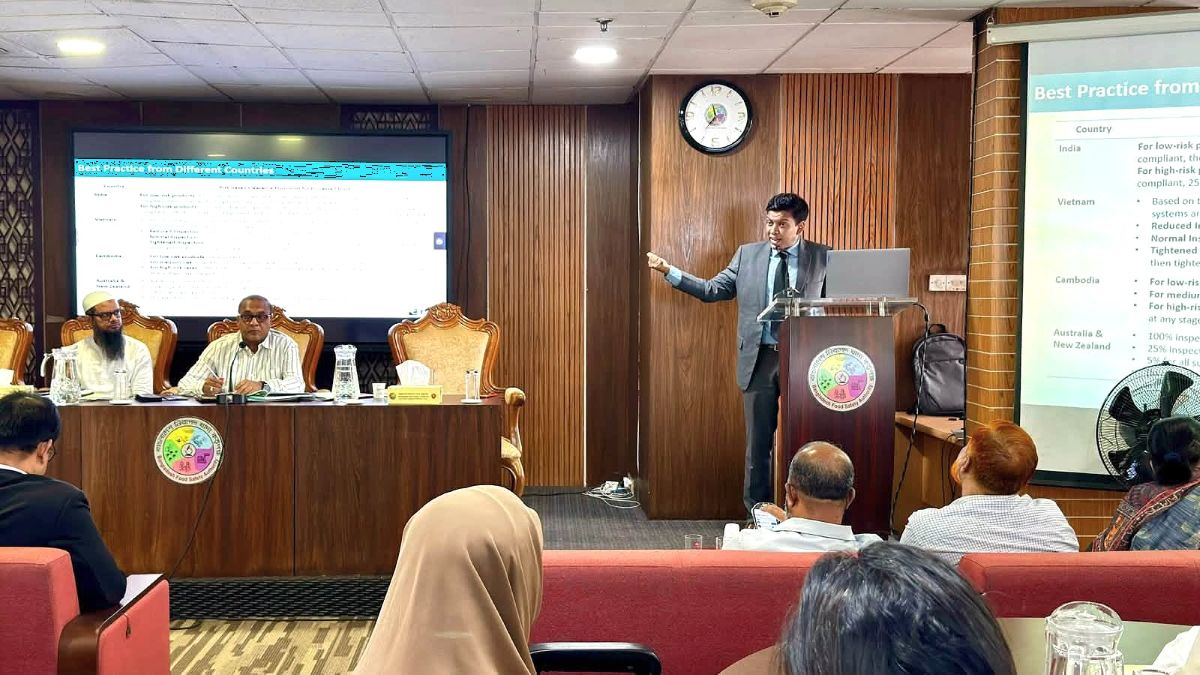
The Bangladesh Food Safety Authority (BFSA) held a stakeholder workshop on 24 September 2026 to finalize the “Electronic Governance of Safe Food (Import) Guidelines, 2026." TRACE Consulting CEO Fuad M. Khalid Hossen and Head of Trade Facilitation and Regulatory Compliance Mohammed Mahraj-ul-Alam Samrat took part as invited discussants and presented technical inputs on the draft. The BFSA chairman chaired the session. Senior BFSA officials attended, along with representatives from the Ministry of Food, Ministry of Commerce, NBR, Department of Livestock Services, BSTI, Bangladesh Land Port Authority, government laboratories, and trade associations.
The Guidelines build on work TRACE's team led under the former USDA Bangladesh Trade Facilitation (BTF) Project. The team developed an electronic-by-design framework for safe food imports, including the regulations and Bangladesh's first electronic guidelines in this area. It also worked with the Ministry of Commerce to include key provisions in the Import Policy Order (IPO) 2026–2029. The Ministry accepted several BTF recommendations, most notably making clearance of non-BSTI food items fully digital. This covers pre-arrival processing, automated risk management, post-clearance controls, laboratory connectivity, and Customs integration. The team also developed BFSA's National Food Import Information Management System (NFIIMS) (import.bfsa.gov.bd) to support implementation.
Discussion focused on whether Bangladesh and BFSA are ready to implement the framework. The CEO noted that BFSA's jurisdiction now covers all food items except the 33 BSTI-regulated products under the IPO, so risk profiling of every product at once is not feasible. He recommended that BFSA begin with 50 to 100 priority products, finalizing their risk profiles and testing parameters before expanding coverage. He also stressed the need for awareness among importers and stakeholders, so the system is seen as a way to facilitate trade rather than a burden. Once fully operational, the approach is expected to cut average food clearance time from around 15 days to just a few days while making the process more efficient, transparent, and risk-based.
The presentation also covered BFSA's mandate under the Food Safety Act, 2013, and the relevant IPO provisions. It described electronic importer registration, No Objection Certificates, pre-arrival notification, and coordinated testing and clearance with Customs. It drew on risk-based clearance practices from India, Vietnam, Cambodia, Australia, and New Zealand and proposed a dedicated Risk Management Unit within BFSA.
With BFSA's role now reflected in the new IPO and the Guidelines nearing implementation, TRACE remains committed to supporting a faster, more transparent, and internationally aligned food import system for Bangladesh.