 LinkedIn
 Email
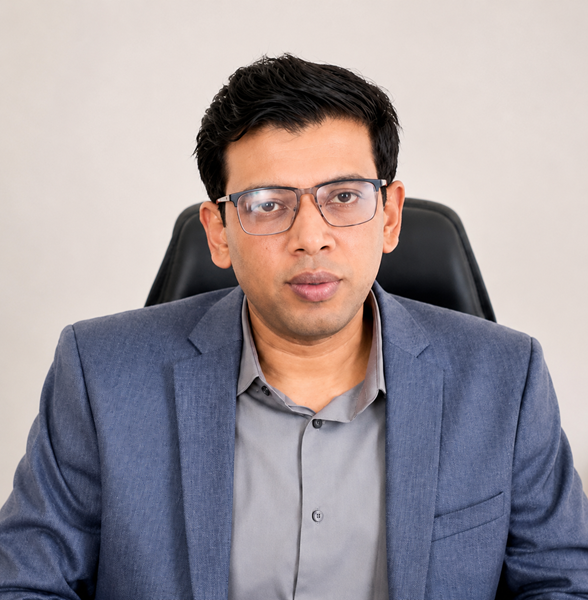
About Fuad M Khalid Hossen
Fuad M Khalid Hossen is the Chief Executive Officer of TRACE Consulting and one of Bangladesh’s leading experts in trade facilitation and trade policy reform, with more than 14 years of experience across international trade, regulatory reform, customs modernization, SPS, digital transformation, and institutional development. He has led and contributed to high-impact national reforms that changed how trade-related policies, regulations, institutions, and digital systems operate in practice, improving access to regulatory services and trade processes for thousands of businesses, traders, and regulatory service users across Bangladesh.
Across his career, Fuad has worked with more than 50 public and private institutions, led or contributed to 30+ policy and regulatory reforms, supported the deployment of 14 trade-related IT systems, and helped establish 7 specialized trade units and risk-management systems. His work has included major national initiatives such as the Bangladesh National Single Window, customs modernization, tariff and import-policy reform, risk-based border control, and institutional strengthening of cross-border trade agencies.
One of his major policy contributions was supporting the incorporation of significant trade facilitation reforms into Bangladesh’s Import Policy Order 2026–2029, aimed at modernizing the import regime through regulatory simplification, greater transparency, risk-based approaches, and more efficient clearance procedures.
Since establishing TRACE Consulting in 2025, Fuad has led its development into a multidisciplinary advisory firm working with government institutions, development partners, laboratories, trade associations, and private-sector organizations. Within its first year, TRACE secured 17 assignments, including four World Bank-financed projects, across trade facilitation, policy and regulatory reform, customs modernization, agricultural policy, digital solutions, laboratory strengthening, and institutional development.
As CEO, Fuad provides strategic and technical oversight across TRACE’s portfolio, leads engagement with government and development partners, develops partnerships and consortium arrangements with national and international firms, and guides multidisciplinary teams delivering advisory and implementation assignments.
Among TRACE’s major current projects, Fuad serves as Team Leader for the World Bank-financed Technical Assistance for Repurposing of Agricultural Public Support Towards a Sustainable Food Systems Transformation in Bangladesh (TARAPS) under the Department of Agricultural Extension and Ministry of Agriculture. The assignment focuses on agricultural policy reform, public expenditure and subsidy analysis, policy realignment, and options for making agricultural public support more sustainable, efficient, equitable, and climate-responsive.
He also manages TRACE’s contribution to the World Bank-financed Time Release Study at Key Custom Houses, Package SD-13, under the National Board of Revenue’s Customs Modernization and Infrastructure Development Project. Over 21 months, the assignment will undertake around 18 baseline, midline, and end-line Time Release Studies across six major customs locations, applying the World Customs Organization methodology to measure release times, assess progress, identify bottlenecks and redundant procedures, and support evidence-based improvements in customs clearance.
Fuad also oversees TRACE’s technical contribution to the Bangladesh Trade Portal e-Learning Platform under the Ministry of Commerce. The initiative is developing more than 20 bilingual learning modules covering WTO rules, import-export procedures, SPS and TBT measures, trade facilitation, tariff classification, rules of origin, trade remedies, digital trade, trade finance, and regulatory compliance.
Under his leadership, TRACE has also developed a growing portfolio in laboratory strengthening and quality infrastructure. The firm is supporting the BITID Rodolphe Mérieux Laboratory on ISO 15189:2022 accreditation readiness and has undertaken laboratory-related assignments involving CDIL, BSTI, PTRTC at CVASU, PRAN Quality Control Laboratory, Fishtech Laboratory, and Chattogram Custom House. These engagements cover laboratory accreditation, quality-management systems, laboratory information management systems, proficiency testing, testing capacity, infrastructure planning, and regulatory compliance.
Before establishing TRACE, Fuad served as Deputy Chief of Party and Technical Lead of the USD 32.4 million USDA-funded Bangladesh Trade Facilitation Project. In this role, he managed large-scale reforms across food and agricultural trade, including import and export policy reform, SPS and quarantine modernization, veterinary and feed regulations, digital regulatory systems, laboratory strengthening, traceability, export compliance, and risk-based border controls.
Alongside the broader portfolio of high-impact policy, regulatory, digital, and institutional reforms undertaken under his leadership at BTF, Fuad supported the modernization of 12 laboratories, including the establishment of the National Halal Laboratory at BSTI, and helped government agencies strengthen compliance systems, risk management, traceability, and electronic service delivery. He also supported Government of Bangladesh institutions in preparing and submitting WTO notifications, strengthening Bangladesh’s engagement and credibility in the multilateral trading system.
Fuad’s experience with Time Release Studies spans different stages of his career. His first exposure came through IFC-supported customs modernization work, where he supported follow-up implementation of post-TRS recommendations and was introduced to more system-based approaches using ASYCUDA World data. Later, under the USDA Bangladesh Trade Facilitation Project, he managed the team and firm that conducted Bangladesh’s first agro-product-focused TRS covering HS Chapters 1–24. He is now returning to this area through TRACE’s work on NBR’s nationwide TRS assignment.
Earlier, with IFC – World Bank Group, Fuad contributed to trade-facilitation and customs-modernization initiatives including the Online Licensing Module for CCI&E, tariff reform, customs modernization, and WTO Trade Facilitation Agreement implementation. He has also worked with FCDO-funded programmes on regulatory simplification, export diversification, automation, and governance reform.
Beyond project leadership, Fuad regularly contributes to national discussions on trade policy, investment, competitiveness, customs modernization, and regulatory reform through television programmes, policy forums, and national newspapers. He holds Bachelor’s and Master’s degrees in Public Administration, specializing in Public Policy, from Jahangirnagar University.