
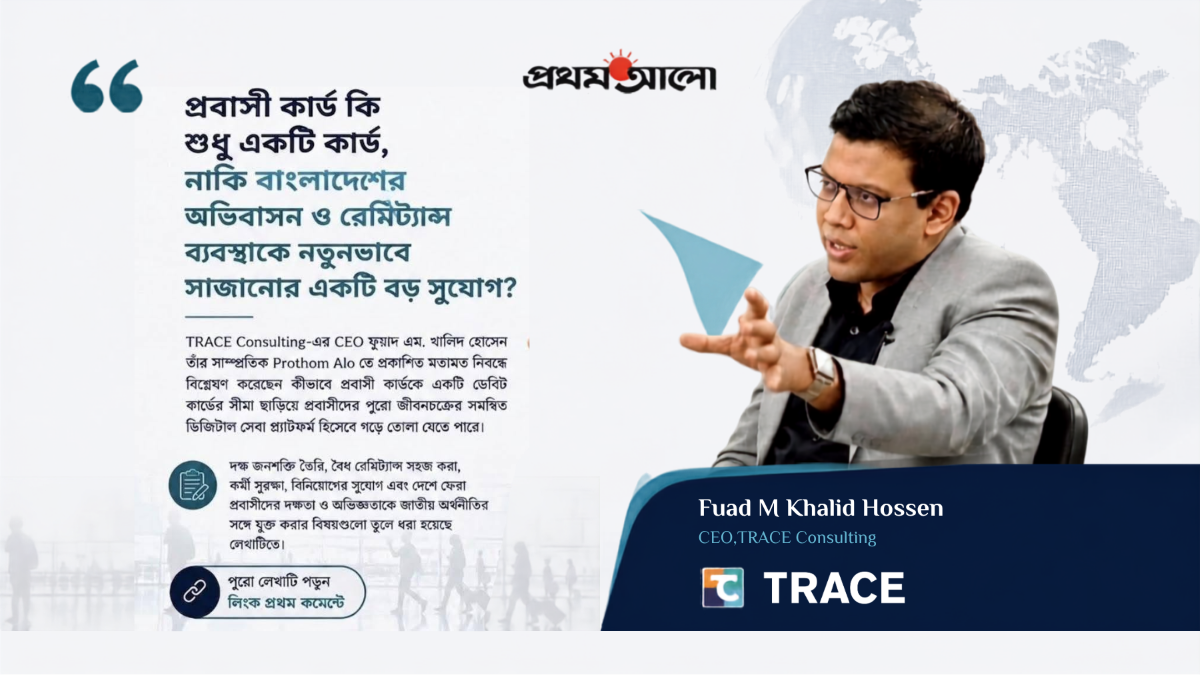
Can the Expatriate Card Bring Positive Changes to the Migration and Remittance System?
Reimagining Migration and Remittance Services Through the Expatriate Card
Expatriate Bangladeshis are one of the country's greatest economic strengths. Yet, throughout the entire migration journey from searching for a job to recruitment, training, obtaining clearances, ensuring protection abroad, supporting families back home, and starting a new life after returning, migrant workers still have to navigate fragmented and complex service systems. While their contribution to the economy is highly visible, the state's service delivery structure is still not sufficiently coordinated.
Against this backdrop, the government's Expatriate Card initiative should not be viewed merely as another card; rather, it represents a major opportunity to restructure the entire expatriate service system. The government is set to launch a pilot of the Expatriate Card next month through the state-owned Janata Bank. The initiative aims to distribute 50,000 cards by December this year and 200,000 cards by June next year. The plan includes improving social recognition, providing financial incentives, and facilitating international payment and banking services.
It is important to remember that expatriate Bangladeshis do not only send foreign currency to the country; they also keep the livelihoods, consumption, savings, investments, and local economies of millions of families running. Therefore, the success of the Expatriate Card should not be measured simply by the number of cards distributed. The real questions are the following: Will it make sending remittances through legal channels easier and more attractive than hundi? Will it ensure rapid government assistance when workers face difficulties abroad? Will it make it easier for their families to access services at home? And will it be able to effectively connect the skills, experience, and savings of returning migrant workers with the country's economy?
Not Just a Card: What Is Needed Is a Life-Cycle-Based Service
If the Expatriate Card is viewed merely as a debit card, its potential will remain limited. It needs to be developed as a digital service platform covering the entire life cycle of a migrant worker.
The first step could be a verified database of overseas job opportunities. Workers should be informed in advance about the types of workers needed in different countries and professions, the required skills, salary, employer information, recruitment costs, and contract duration. No job information should be published on the platform without verification by a Bangladesh mission or an authorized authority. This would reduce the influence of brokers and intermediaries while also giving the government a clearer and more realistic picture of demand in the international labor market.
Bangladesh still sends a large number of unskilled and semi-skilled workers abroad, while demand for skilled and specialized workers in the international labor market is increasing rapidly. Therefore, the true measure of success should not simply be how many people go abroad, but rather what skills they take with them and how much they earn.
Through this platform, a worker would be able to see what training and certifications are required for their desired job and where they can obtain them. Once training certificates are added to their digital profile, authorized recruitment agencies and employers would also be able to easily identify and verify skilled workers.
At the next stage, all information, including BMET registration, training and skills certificates, medical reports, insurance, employment contracts, salary details, migration costs, and clearances, would be stored in the worker's personal digital profile. Before leaving for the airport, the worker would be able to verify whether the terms and conditions stated in the official documents match the actual employment contract.
While abroad, there should be a centralized digital system for submitting complaints, insurance claims, or requests for emergency assistance. Workers should be able to track the progress of their complaints, which could then be automatically forwarded, where necessary, to the Bangladesh mission, BMET, the Wage Earners' Welfare Board, or the relevant institution.
Finally, the skills and experience acquired by returning workers must be connected to employment opportunities, entrepreneurship support, and other economic opportunities. In other words, the entire migration life cycle from skills development before departure to the reuse of those skills after returning home needs to be brought under an integrated digital service system.
Making Legal Channels More Convenient
According to research by the Refugee and Migratory Movements Research Unit (RMMRU), 40–45 percent of remittances to Bangladesh come through hundi. This large informal flow demonstrates that regulatory measures alone are not sufficient; sending money through legal channels must be made easier, faster, and more financially rewarding.
The Expatriate Card could play an important role in this regard. The government has announced plans to introduce remittance reward points and credit scoring under the initiative. These benefits need to be implemented in a way that provides expatriates with both immediate and long-term advantages for sending remittances through legal channels.
Reward points could be credited to an expatriate's account based on the amount and regularity of remittances sent through formal channels. However, these should not be limited to symbolic rewards. The points could be used to pay remittance or banking fees, insurance premiums, airport and expatriate services, or fees for specific government services. Higher reward tiers could also be introduced for regular remittance senders.
Credit scoring must also have tangible financial value. Many expatriates send money to Bangladesh year after year, but because they do not have conventional salary records or a formal credit history, banks cannot adequately assess their financial capacity. If the amount and consistency of remittances were incorporated into their financial profiles, banks could use this information to assess credit risk when providing loans.
However, more important than reward points and credit scoring is the actual experience of sending money. An expatriate should be able to send money from home through a mobile app or digital platform in just a few simple steps, while their family should be able to receive it instantly in a bank account, through mobile financial services, or on a card. Complicated procedures, additional travel, and long waiting times put formal channels at a disadvantage in the competition with informal channels.